
The Real Shift: Edge AI Is Moving From “What’s Possible” to “What’s Deployable”

By Kannan Srinivasagam | WG Tech Solutions
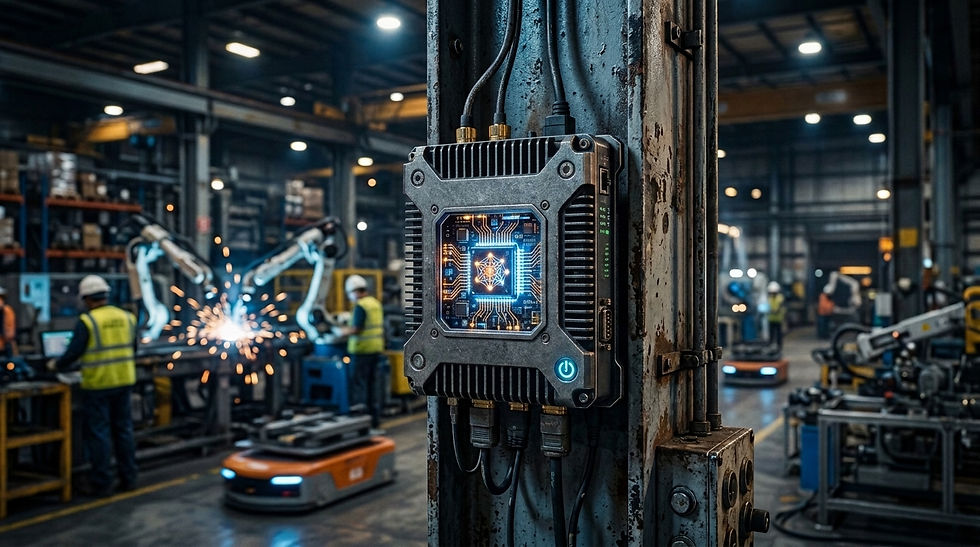
For years, the AI community has been obsessed with theoretical ceilings. But product teams live in the opposite world—they care about floors:
Minimum latency
Minimum power
Minimum cost per device
Minimum failure rate
That’s where edge AI stops being a niche experiment and becomes a necessity. Not because it’s trendy, but because the physics, economics, and user expectations of real-world systems demand it.
Why Edge AI Is No Longer Optional
The constraints shaping the next decade of AI aren’t obstacles—they’re the design space.
1. The world is not a data center
Most AI systems don’t live in clean, climate‑controlled racks. They live:
on factory floors
in retail stores
on highways
in warehouses
in rural areas with unreliable connectivity
Cloud‑only AI simply cannot meet the reliability and latency requirements of these environments.
2. Privacy and sovereignty are now major requirements
Data can’t always leave the device. Regulations, customer expectations, and competitive sensitivity all push intelligence closer to where data is generated.
3. Latency is a product feature
If your system needs to react in under 50ms, the cloud is already too far away. Edge AI isn’t a nice-to-have—it’s the only architecture that works.
4. Cloud inference costs don’t scale
As AI becomes embedded in every product, per‑call inference pricing becomes a bottleneck. Based on recent market data, edge processing has been estimated to cost 40–60% less over the lifetime of a deployment for consistent, high-volume inference workloads once hardware and deployment costs are amortized. Edge shifts the economics from renting compute to owning capability.
5. Energy efficiency is the new performance metric
The next wave of AI innovation is not about more FLOPs—it’s about more intelligence per watt.
The Stigma Around Edge AI Is a Legacy Problem
Edge AI still carries the reputation of being “hard,” “fragile,” or “specialized.” But that perception is rooted in the world of 2018–2021, when:
hardware was fragmented
toolchains were immature
deployment pipelines were brittle
optimization required deep hardware knowledge
That world is gone.
Today, vertically integrated edge AI stacks—hardware, firmware, runtime, model optimization, application software—are making edge deployments predictable, repeatable, and scalable. This is exactly the direction WGTech is headed.
Edge Environments Force the Right Questions
When you design for the edge, you can’t hide behind unlimited compute or perfect connectivity. You’re forced to confront the questions that determine whether an AI system will survive in the wild:
How much accuracy is worth trading for deterministic latency?
How does the model behave when lighting changes, sensors age, or data drifts
What’s the recovery path when the system fails?
Can the model run consistently for months without human intervention?
These aren’t constraints to be “worked around.”
They are the engineering truths that shape reliable AI.
Constraints First Design with Edge AI is the new Frontier
The cloud era was defined by abundance. The edge era is defined by constraints—and constraints are where engineering becomes real innovation.
Teams optimize for accuracy curves, leaderboard metrics, and idealized datasets, only to discover late in the cycle that the real world doesn’t care about any of that.
The industry is slowly realizing that the next wave of AI isn’t about bigger models or more cloud compute. It’s about intelligence that is efficient, robust, predictable, local, real‑time and cost‑aware.
In other words: intelligence that respects the constraints of the physical world.
Edge AI isn’t a niche. It’s the proving ground for the next generation of AI engineering.
Interested in learning more about how we are implementing and deploying these Full Stack Edge AI architectures at WG Tech? Contact us at WGtech.ai.

Kannan Srinivasagam
Founder & CEO, WG Tech

Technology and product executive with diverse and extensive experience (25+years) in engineering, business development, sales and marketing. Demonstrated track record of growing businesses in the networking, automotive and consumer domains having delivered multiple products from marketing requirements to multi-year product shipments. Diverse skillsets including managerial, visionary leadership and technical account positions managing portfolios and teams in end-to-end product design and development.


Comments